
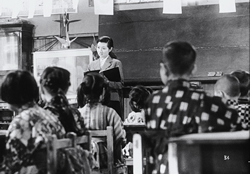
Twenty-four Eyes
Dir/Scr: Kinoshita Keisuke
Orig Story: Tsuboi Sakae
Cast: Takamine Hideko, Hideki Goko,
Watanabe Yukio, Miyagawa Makoto
1954 / B&W / 35mm / Japanese / Chi & Eng Subtitles / 155min
Twenty-four Eyes is the epic story of a teacher’s relationship with 12 students (to whom belong the eyes in the title), members of the first class she teaches. Adapted from a novel by Tsuboi Sakae, it is set in an island in the Inland Sea, following the teacher and the children in their ups and downs through an eventful, turbulent time in modern Japanese history, from the nationalistic pre-war period in the 1920s through the early post-war years in the 1940s. The film is an anti-war classic held dear by the Japanese through generations, remaining an audience favorite some 50 years after its initial release, to the extent that the
picturesque island on which the film was shot has become a tourist attraction.
Director Kinoshita Keisuke is a seminal figure in Japanese cinema, more admired in his home country than such internationally renowned directors as Ozu Yasujiro, Mizoguchi Kenji and Kurosawa Akira. Twenty-four Eyes was in fact a bigger hit in Japan than Ozu’s Tokyo Story (1953) and Kurosawa’s Seven Samurai (1954).
This restored version of the film is part of Shochiku’s effort to preserve its library of films. The company collaborates with IMAGICA, Japan’s most revered post-production company, to make digital re-masters for some of its important titles. Each project costs around ¥20 - 50m (about HK$1.8 million - 4.5 million). The original films are scanned, and repair work such as color correction and de-noising is performed. For some films, Twenty-four Eyes included, 35mm prints are struck, but the ultimate goal is to produce works in HDCAM format for digital cinema and DVD.
| 3/10 | (Sun) | 2:30pm | Cinema, Hong Kong Film Archive |
Post-screening talk with Sam Ho and Elbe Lau

The contents of the programme do not represent the views of the presenter.
The presenter reserves the right to change the programme should unavoidable circumstances make it necessary.
