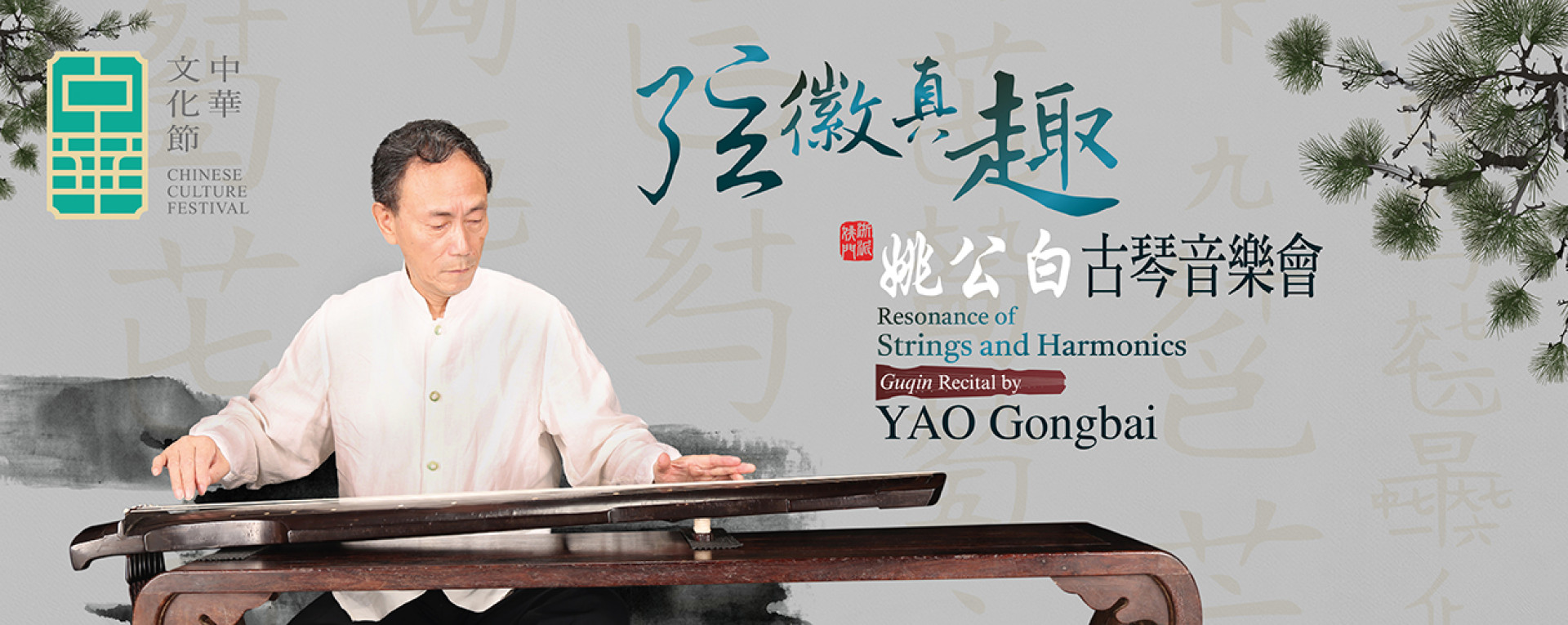
Chinese Culture Festival 2026: 'Resonance of Strings and Harmonics': Guqin Recital by Yao Gongbai
ProgrammeAbout the PerformerTicketing and Enquiries
Guqin embodies the essence of over 3,000 years of Chinese cultural tradition. This concert features a special recital by Yao Gongbai, among the first batch of representative inheritors of the art of guqin as an Intangible Cultural Heritage at the national-level, who has devoted nearly 70 years to the instrument. Of the eight selected works spanning the Ming and Qing dynasties, four originate from the earliest extant guqin tablature collection, Shenqi Mipu (1425), and were reconstructed through deciphering historical guqin tablature by Yao’s father, Yao Bingyan. A particular highlight is the world premiere of Flowing Water from Zhifa Huican Quejie (1821). This version marks its transition from poetic abstraction to musical realism, and sheds light on the fascinating history underlying the 1977 version of Flowing Water being launched into outer space by the National Aeronautics and Space Administration (NASA).
Programme:
Lamenting the Past and Autumn Thoughts at Dongting Lake
High Mountain
Dialogue Between the Fisherman and the Woodcutter
Pure mind
Autumn Moon over Thatched Pavilion & Longing for a Friend in the Mountains
Hujia Melody
Flowing Water
Guangling San
The performance will run for about 2 hours including a 15-minute intermission.
Tickets available from 14 April at all URBTIX outlets, self-service ticketing kiosks, on internet, by mobile app and telephone booking.
First batch of representative inheritors of the art of guqin as an Intangible Cultural Heritage at the national level
Yao Gongbai
Yao Gongbai is a distinguished guqin virtuoso and was named a representative inheritor of the art of guqin as a national-level Intangible Cultural Heritage in 2008. He is president of the Jinghe Qin Society, researcher at the Cultural Department of Chi Lin Nunnery in Hong Kong, part-time guqin lecturer at the Hong Kong Academy for Performing Arts, and a visiting professor at the Academy of Chinese Studies, Shenzhen University.
Born into a family with an eminent guqin tradition, Yao Gongbai began his musical training under the guidance of his father, the renowned guqin master Yao Bingyan, and later studied with Wu Zhenping and Zhang Ziqian. Deeply rooted in the Zhejiang Yao School, he has devoted nearly seven decades to continuous practice, developing a personal style noted for his clean and fluent fingering and a deep, unworldly atmosphere. His artistry has placed him at a distinctive position among contemporary traditional guqin artists. Yao is particularly acclaimed for his interpretation of the guqin repertoire reconstructed by Yao Bingyan, including the Hujia series, Guangling Melody and Magpies Crying at Night. In addition, he has reconstructed a number of renowned works such as Cranes Singing High in the Marshes, Elegy on the Riverside and Fostering the Moral Essence, and composed new pieces including Chant of the Reeds, Ode to the Lotus and Ode to Buddhist Chant, merging traditional aesthetics into contemporary creation.
Yao Gongbai has also conducted research on ancient guqin fingering technique, the evolution of guqin pieces, and guqin temperament, with considerable insight. Alongside performance and research, he has focused in recent years on the systematic documentation and study of Yao Bingyan’s guqin legacy, resulting in major publications such as Reconstruction of Qin Melodies from Ancient Scores (2018) and Manuscripts on Guqin Studies by Yao Bingyan (2019). He has been actively engaged in teaching and promoting guqin art for many years. His students spread throughout the world. He is a distinguished lecturer and performer at academic and cultural institutions worldwide.
Information provided by the Artist
Chinese Culture Festival 2026: 'Resonance of Strings and Harmonics': Guqin Recital by Yao Gongbai
Tickets are available from 14 April at all URBTIX outlets, self-service ticketing kiosks, on internet, by mobile app and telephone.
Half-price tickets are available for full-time students, senior citizens aged 60 or above, people with disabilities and the minder and Comprehensive Social Security Assistance (CSSA) recipients. Tickets for CSSA recipients are available on a first-come, first-served basis. Concessionary ticket holders must produce evidence of their identity or age upon admission.
Chinese Culture Festival 2026 Discount Scheme
Limited-Time Offer
(14–30 April)
From 1 May onwards
'Generations Together 1+1' Discount #^
For each standard ticket purchased with 1 student/senior concessionary ticket for the same performance
Discount on the standard ticket
15% off
Discount on the standard ticket
10% off
Group Booking Discount #^
For each purchase of standard tickets
Discount on the standard ticket
4–9
15% off
10% off
10–29
20% off
15% off
30 or above
30% off
25% off
Package Booking Discount #^
Number of programmes in each purchase of standard tickets
Discount on the standard ticket
3–4 different programmes
15% off
10% off
5–6 different programmes
20% off
15% off
7 or more different programmes
30% off
25% off
Exclusive Offer to Museum Pass Holders #^
Museum Pass Holders can enjoy 10% off discount for each purchase of 1 or more standard ticket.
This discount is available for purchases at URBTIX outlets only. Please present a valid physical or electronic Museum Pass upon purchase.
----------------------------------------------
# Only applicable to tickets for stage programmes, Chinese Opera Festival 2026: Chinese Opera Film Shows and Legacy and Vision: Conversations with Chinese Cultural Masters. Discount is only available for tickets for Musical Pan Yu Lin by Actors’ Family and Children Arts Tech Music Theatre 5 Elements East West by Zuni Icosahedron purchased through URBTIX on a first-come, first-served basis.
^ Discount is not applicable to ticket purchases of the following programmes: International Arts Carnival 2026: Nanyin Theatre Siu Hei’s Musical Journey: Poetry in Nanyin by One Table Two Chairs Charitable Foundation, Grand Dance Poem In Between — Wu Guanzhong’s Ink Odyssey by Hong Kong Dance Company, The Diary of Song 2026 by Hong Kong Repertory Theatre, Realising Art in Social Realism: The Miracle of Union Film, Journeys to the West: Cinematic Dialogues Across Time, Gems of Chinese Opera Film and 2026 ‘Music-Get-Together’ Music Office Trainees’ Concerts — Chinese Music.
Patrons can enjoy only one of the above discount offers for each ticket purchased. Please inform the box office staff at the time of purchase.
For more discount details of Chinese Culture Festival 2026, please visit the website of Chinese Culture Festival
Programme Enquiries: 2268 7321
Ticketing Enquiries and Customer Service:3166 1100

 DATE
DATE  VENUE
VENUE  PRICE
PRICE