Lyric Pieces Book III, Op. 43, No. 2 Ensom vandrer (Solitary Wanderer)
Lyric Pieces Book V, Op. 54, No. 4 Notturno
Lyric Pieces Book X, Op. 71, No. 3 Småtrold (Puck)
The performance will run for about 1 hour and 30 minutes including a 20-minute intermission.
Members of the audience are strongly advised to arrive punctually. Latecomers and those who leave their seats during the performance will only be admitted and allowed to return to their seats respectively during the intermission or at a suitable break. The presenter reserves the right to refuse admission of latecomers, or determine the time and manner of admission of latecomers.
The programme does not represent the views of the Leisure and Cultural Services Department.
The presenter reserves the right to change the programme.
“...born of a prodigious virtuosity of imagination outrageous in its beauty” The Times
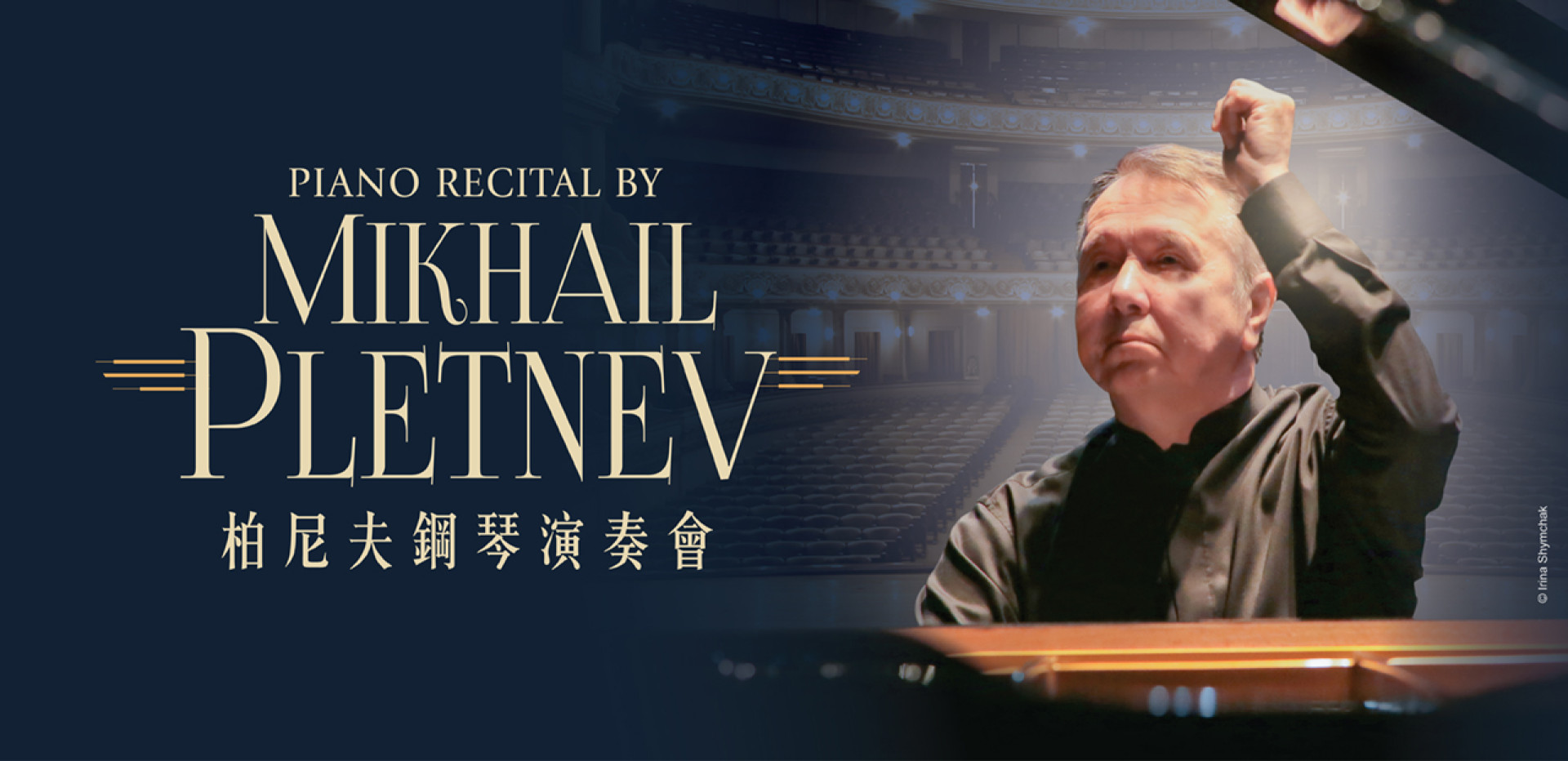
Mikhail Pletnev is one of the most respected and influential artists of our era. His prodigious talent as a pianist, conductor, and composer has earned widespread acclaim ever since the 1978 Tchaikovsky International Piano Competition, where he won First Prize at the age of 21. An invitation to perform at a 1988 diplomatic summit in Washington led to Pletnev’s friendship with Mikhail Gorbachev and a lifelong commitment to dismantling barriers through the universal language of music.
In 1990, Pletnev formed the Russian National Orchestra – the first independent orchestra in Russia’s history. Under his leadership, the RNO achieved recognition as one of the world’s great orchestras. Over thirty years later, Pletnev has renewed his commitment to artistic freedom with his founding of the Rachmaninoff International Orchestra, named after the celebrated pianist, conductor, and composer whose own career inspired audiences from all corners of the globe.
Pletnev’s performances and recordings have shown him to be an outstanding interpreter of an extensive repertoire, both as pianist and conductor. His recordings have earned numerous prizes, including a Grammy Award, the Diapason d’Or, ECHO Klassik Award, Choc du Monde de la musique, and a Gramophone Award.
Pianist, conductor, composer and cultural leader — all are significant facets of Mikhail Pletnev's remarkable life. Yet with his characteristic humility, he insists that he is, simply, a musician.
Information provided by the artist
Piano Sonata No. 8 in C minor, Op. 13, “Pathétique”
Ludwig van Beethoven (1770-1827)
Grave - Allegro di molto con brio
Adagio cantabile
Rondo: Allegro
The “Pathétique” Sonata, written in 1798, is a watershed in Beethoven's early compositions: it breaks the balanced framework of classical sonatas and constructs a narrative with harmonic contrast and motivic developments, which paths the way for classical sonata towards the spirit of romanticism.
The first movement opens with a heavy C minor Grave. The diminished seventh chords smash like the iron hammer of fate, and the left-hand low notes are like the thunder before the storm. In the subsequent Allegro, the fiery syncopated rhythm is intertwined with impulsive arpeggio, showing Beethoven's characteristic "confrontational motive": the right-hand melody keeps struggling upwards, but is dragged back to the abyss by the stubborn left-hand bass.
It is noteworthy the diverse interpretations by pianists of different schools. Artur Schnabel, the founder of the German-Austrian School, takes the formal structure and motivic logic as the core. The first movement diminished seventh chords are interpreted analytically as philosophy, and the left-hand trills are as accurate as the clock’s gear, showing the rational glory of "absolute music". Alfred Cortot, a master of the French School, deconstructed the classical framework with an impressionistic view, and turned the left-hand trills in the first movement into the ripples of Debussy’s style.
The second movement, Adagio cantabile, is modulated to A-flat major. The hymn-like theme flows on the broken chords, with an unspoken pain in the purity, as if the brief tranquillity in the eye of the storm. The final Rondo: Allegro unfolds with the dual character of “confrontation and reconciliation". The C minor theme has the vigour of folk dance music, but the middle part turns into a bright C major, and finally ends in a lofty posture of the fast flow, heralding the arrival of the "heroic era" in Beethoven's works.
Piano Sonata No. 14 in C-sharp minor, Op. 27, No.2, “Moonlight”
Ludwig van Beethoven (1770-1827)
Adagio sostenuto
Allegretto
Presto agitato
The "Moonlight" Sonata, completed in 1801, subverted the classical form with the subtitle of "Quasi una fantasia". The famous first movement is like ripples on the mirrored lake, and the right-hand melody is suspended in the mist created by sustained pedals. Is the atmosphere of the movement reminiscent of the reflection of the moonlight or the echo of the abyss? The second movement, a D-flat major minuet, blooms naivety and brief elegance, which is actually the mask of tranquillity before the storm. The final movement's rapid arpeggio and stormy chords are like volcanic eruptions, as if the composer intends to write the sonic tsunami in the history of piano music.
Kempf, pianist of the German-Austrian School, explored the authenticity of the score with cold and crystal clear touching. The use of pedal in the first movement was restrained like the moonlight penetrating the prism; Richter of the Russian School played the triplets with a Gothic gloom, and the left-hand octaves of the last movement like a roaring avalanche; Gieseking of the French School displayed the magic of impressionism and made the first movement turning into the premonition of the past life of Debussy's Clair de Lune. From the sonic mist created by the use of pedal of the first movement, to the stormy aesthetics that surpasses the limits of the piano in the final movement, this amazing masterpiece "Moonlight" Sonata is really Beethoven's exploration of his revolutionary sonic space.
Sixteen Lyric Pieces
Edvard Grieg (1843-1907)
Grieg's piano works are famous for their exquisite poetry and rich nationalistic colour. His Lyric Pieces has a total of 10 Books and 66 pieces, which can be compared to a diary written in musical notes. In this concert the selected 16 pieces will lead the audience to feel the breath and trembling soul of the Nordic landscape.
Fedrelandssang (National Song), Op. 12, No. 8
The work unfolds with a solemn hymn: the continuous bass chord of the left hand, like the church bell echoing the sense of fjord space. The melody on the right hand is in the scale of Norwegian folk music, which is like a tribute to the towering mountains.
Berceuse (Cradle-Song), Op. 38, No. 1
The ongoing triplet accompaniment recalls the rhythm of the mother's cradle, and the melody lines interweave in the high and low voices, as if the moonlight shines through the pine forest and kisses the baby's forehead.
Sommerfugl (Butterfly), Op. 43, No. 1
The agile sixteenth-notes seem to depict the butterfly wings, allowing Russian School pianists to show off typically their virtuosic skills. The middle section suddenly turns into minor key, like a brief shadow passes by, hinting at the fragility and transient beauty of nature.
Elegie, Op. 38, No. 6
This piece shows the depth of tragic music by Grieg. In the beginning, the harmonic structure of the funeral march is dramatic, and its sorrow is enhanced by the mid-range voice, sobbing with the semitone descending figures. The fermata pause is like the eternal silence of the Nordic land.
Melodie, Op. 38, No. 3
The lyrical line of the right-hand melody is improvisatory, while the left-hand marks the passage of time with precise rhythmic vitality.
Smagfugl (Little Bird), Op. 43, No. 4
The decorative clusters of notes in the high register imitate the song of birds, and the left-hand syncopated rhythms presents the primitive pulsation reminds us of Stravinsky, showing the composer's precise control of the dramatic tension of tone painting.
Baekken (Brooklet), Op. 62, No. 4
Semiquavers in groups of three beats run through the whole piece, and the stream gradually changes from whispering to rushing.
Hjemve (Nostalgia), Op. 57, No. 6
This piece opens with a lonely melody, and each note is like a frozen teardrop. The gradually stacked harmony flashes back like memory fragments. The middle part turns into bright major key, but suddenly falls silent at the climax, leaving the lonely melody shrouded in the reverberant Siberian mist.
Valse impromptu, Op. 47, No. 1
At the beginning, the special technique of the left hand crossing the right hand creates the illusion of floating in the air. The explosive power of the middle section hints at Liszt's evil charm. Deliberately twisting of the strong beat creates the dance-like elegance of the uneven drunken steps.
Bestemors menuett (Grandmother’s Minuet), Op. 68, No. 2
With a strong feeling of nostalgia, the main part is contrasted with the mechanical texture that imitates the old-fashioned music box, and the slightly clumsy rhythm reminds the mechanical dance rhythm in Shostakovich's music.
Svunne dager (Vanished Days), Op. 57, No. 1
Together with the nostalgic and elegant waltz rhythm, the melody has the kind of melancholy in Rachmaninoff’s music. However, the frequent transformation of keys and the fragmented musical motives suggest that memories are unreliable and in the process of disappearing.
Sommeraften (Summer Evening), Op. 71, No. 2
The image of the evening breeze is transformed into a dense arpeggio texture, where Grieg shows the hazy impressionistic harmony as in Debussy’s piano music.
Scherzo, Op. 54, No. 5
This dazzlingly difficult piece intertwines the left-hand jump and the right-hand fast musical figures into a sharp satirical elf's prank. The dreamy nocturne passage in the middle part is gradually twisted into a chaotic end.
Ensom vandrer (Solitary Wanderer), Op. 43, No. 2
Here we return to the cold and vast sense of space displayed by pianists of the Russian School. The lonely melody wanders between the empty harmony in fifths, and the sustained sonic space lingers as if the endlessly extending snow footprints in the long shot of Tarkovsky's movie.
Notturno, Op. 54, No. 4
This piece shows the pinnacle of Grieg's harmonic language. The main melody in the upper layer is stacked on sustained low notes. In the F-sharp centred middle section, the left-hand crosses to play the some high notes just like the aurora night sky.
Småtrold (Puck), Op. 71, No. 3
The trills and staccato notes with the strange parallel fifth intervals, depict the Nordic legend’s elf prank. In the middle section, the roar in the bass register of the left hand and the giggle of the high notes of the right hand form a contrasting dialogue, as if paying tribute to the wild aura from Beethoven’s “Tempest" Sonata.
Programme notes by Koho
(Researcher in performance studies, travelling musician in Europe)
Tickets available from 3 Aprilat all URBTIX outlets, self-service ticketing kiosks, on internet, by mobile app and telephone.
Maximum 6 tickets per purchase per person on the first day of ticket sale.
Half-price tickets available for senior citizens aged 60 or above, people with disabilities and the minder, full-time students and Comprehensive Social Security Assistance (CSSA) recipients (limited tickets for full-time students and CSSA recipients available on a first come, first served basis).
"Great Music" Package Discount
10% off for each purchase of standard tickets for ‘Piano Recital by Mikhail Pletnev’ and ‘Concert by The 12 Cellists of the Berliner Philharmoniker’.
"Great Music" Group Booking Discount
For each purchase of standard tickets for ‘Piano Recital by Mikhail Pletnev’ and ‘Concert by The 12 Cellists of the Berliner Philharmoniker’, the following concession applies:
10% off for 4 – 9 tickets, 15% off for 10 – 19 tickets, 20% off for 20 or more tickets.
Patrons can enjoy only one of the above discount offers.
Programme Enquiries: 2268 7321
Ticketing Enquiries and Customer Service: 3166 1100
Telephone Booking: 3166 1288
Internet Booking: www.urbtix.hk
Mobile App: URBTIX
Pletnev: The Piano Maverick
Date: 17 Jun 2025 (Tue)
Time: 6:45pm
Venue: Foyer Reception Area, 4/F, Auditoria Building, Hong Kong Cultural Centre
Speaker: Savio Lau (Music Critic)
Conducted in Cantonese. The talk will run for about 1 hour.
Admission free on a first come, first served basis.


 BUY TICKET