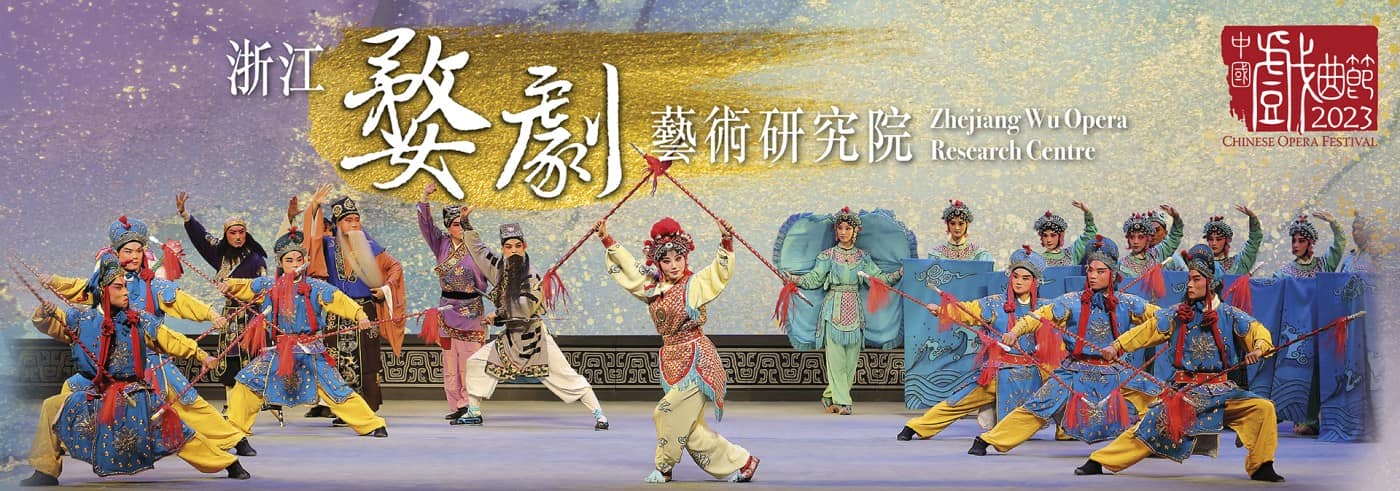
Wu Opera is also known as Jinhua Opera, as it first grew in popularity in the Jinhua region in Zhejiang Province. On stage, it shows a distinct character and style, with equal emphasis on the civil and martial elements, and a seamless integration of both elements in the presentation. Staging is also awe-inspiring and emotionally gripping with fluid choreography, stunning martial art fighting, sonorous music, and characterisation through costumes and outlooks.
This year, the Zhejiang Wu Opera Research Centre returns to Hong Kong by popular demand. The cast of Wu Opera, including Yang Xiayun, Lou Sheng and Chen Lili, will perform classics that feature stylised movements that are unique to the genre. In a full-length production of The Legend of the White Snake, the actors playing White Snake (Bai Suzhen) and Green Snake (Xiaoqing) will move with the ‘snake slither’, Xu Xian will perform many roll-and-flip stunts such as ‘swift leap-and-kneel’ and ‘rolling off the back’. In the excerpt The Broken Bridge, which has come to be acclaimed as the ‘number one Bridge presentation’ in Chinese opera circles, the seamless blending of martial and civil repertoires is a representative display in Wu Opera. Also included in the troupe’s touring performance this time are operatic excerpts that demonstrate traditional skills, martial art routines and stunts, such as the actor’s 'popping up from' and 'falling back into' the crate in Fan Zhongyu Beaten and Thrown into a Crate the flip-and-fall action in full armour in Lu Bu Pacing His Horse, hair-flinging in Catching Sanlang Alive, and the wiggling of the feathers of the headgear in The Party. This visual experience promises to be so thrilling that the audience will applaud and call out for more.
Lyrics and dialogue with Chinese and English surtitles.
Audience is strongly advised to arrive punctually. Latecomers will only be admitted at a suitable break.
21.7.2023 (Fri) 7:30pm
The Legend of the White Snake
The Legend of the White Snake is notable for its elegant and mellifluous singing style and its adept variability, embodying both lyrical and martial elements which complement each other. Many martial scenes feature strident gongs and drums with a dynamic appeal, and incorporate the performing techniques of other modern art forms. The Broken Bridge, in particular, is an excerpt that is representative of a lyrical scene rendered with a martial overtone, and serious drama presented with comedic effects.
The story is taken from the Chinese folklore The Legend of the White Snake. Bai Suzhen, the White Snake, has been practising her magical powers for a thousand years and is able to turn into human form. She finds the lonely life as an immortal too much to bear, and yearns to be among the mortals. She and the Green Snake descend to Hangzhou, where she meets a shop assistant in a herbal shop, Xu Xian, by the West Lake. It is love at first sight for the two of them and they pledge and marry. But Monk Fahai of the Jinshan Temple sees through the snakes’ human forms, and is determined to break up the couple. His many attempts at making Xu Xian cut off from the White Snake succeed, because Xu is of a distrustful character and is not as much in love as the White Snake is. Several incidents follow: the White Snake shows her true form on the day of the Dragon Boat Festival and Xu is shocked to death; she tries to steal the celestial herb on Mount Kunlun to bring Xu back to life; she floods the Jinshan Temple as she wants to bring Xu home; and after many trials and tribulations, the couple meets up again on the Broken Bridge of West Lake. Her determination to save her beloved husband finally touches Xu’s heart, and all ends well for the two.
Main Cast: Chen Lili, Yang Xiayun, Lou Sheng, Li Xuanyu, Ying Fujin, Wu Yanxing, Song Baoduan, Liu Fuming
22.7.2023 (Sat) 7:30pm
Excerpt Reneging on the Marriage
The distinctive stylistic feature of Wu Opera of 'crossing the line between the civil and martial repertories' is largely seen here in Reneging on the Marriage. The luantan play therefore has an archaistic, rustic touch. The singing is emotionally well delivered, as typical of the civil style, while the martial skills are visually stunning. Seeing His Betrothed on the Execution Ground is a strongly emotive scene as the feelings of the male and female protagonists are captured, with deep regret and remorse on the male protagonist’s part vividly externalized.
The play has an alternative title, Cai Wende Running Away. Cai Wende is misled by Cai Xing into believing that the ugly-looking mad woman is his fiancée, so he reneges from the marriage. But he gets into trouble and is arrested at the city gate. His real fiancée Ms Lin comes to visit him when he is on the execution ground. Cai is filled with regret and remorse.
Main Cast: Lou Sheng, Ye Xiaohua
Excerpt Fan Zhongyu Beaten and Thrown into a Crate
The stunts performed by Fan involve repeatedly ‘popping up’ and ‘falling back into’ the crate, all done in/on a wooden crate of only slightly more than 2 ft by 2 ft . Dexterity and immaculate physical stunts are the key: there are split-second falls, flips, re-emergence, turning inside the crate, spinning the body while lying on the lid and at the same time spinning the long hair in circles etc. The actions are so fast that they take the audience’s breath away.
The new national top scholar Fan Zhongyu wants to report the treacherous act of Ge Dengyun, Grand Tutor to His Majesty: his wife has been abducted, and his son has also disappeared. But he is knocked unconscious, then thrown into a crate and discarded in the wilderness. The officers who are sent to find him retrieve the crate, unlock it, and save Fan. The distinguished feature of this excerpt is the stunts performed by Fan of repeatedly “popping up” and “falling back into” the crate, all done within a wooden crate of a relatively small size. The actor needs to demonstrate his dexterity and control through the split-second falls, flips, and re-emergence. He has to turn and change his position inside the crate, and when he pops up, he needs to lie down immediately on the lid of the box, spin his body while keeping his flat position, and spin his long hair in circles. The actions are so fast that they take the audience’s breath away.
Main Cast: Dong Xuyang
Excerpt The Eight Mallets
The highlight of this excerpt is the eye-catching routines, such as fast-wielding of the spear and solid footwork grips of the actors.
The story takes place in the Song dynasty. General Yue Fei is engaged in a battle at Zhuxian Town against Jin forces. Four of Yue Fei’s warriors – Yan Zhengfang, He Yuanqing, Yue Yun and Di Lei – all adept in wielding double sledgehammers as their weapons, are repeatedly defeated by Lu Wenlong, the adopted son of Prince Wushu of Jin. The tide turns at the end when Wang Zuo severs his own arm to give a false cause for him to desert to the enemy’s side. He finds Wenlong and divulges to him the truth about his birth. Wenlong joins the Song warriors to defeat the Jin’s.
Main Cast: Zhou Hongwei
Excerpt Struck by Gold Bricks
This excerpt makes use of the acrobatic techniques of falling, flipping etc. in Chinese traditional theatre to demonstrate Liu Xiu's psychological turmoil after he has killed his ministers, thus vividly depicting the chaotic mental state of the character.
The story takes place during the reign of Emperor Guangwu of Han. His Royal Concubine, Lady Guo, wants to revenge her father’s death as he was killed by Yao Gang, the son of Yao Qi. As punishment, the emperor banishes Yao Gang to the border, but this does not appease Lady Guo. She schemes by plying the emperor with wine, and when he is in an intoxicated state, guides him to order to behead Yao Qi and a group of senior courtiers. Ma Wu is livid and creates a scene at the palace, chasing after the emperor with a gold brick. The emperor locks himself inside his chambers. This infuriates Ma Wu so much that he bashes himself on the head with the gold brick and dies by his own hand. The emperor soon discovers that he has beheaded his ministers. Filled with guilt and regret, he takes his sword to stab the culprit, Lady Guo, to death before he proceeds to the Grand Ancestral Temple where he makes a contrite confession to his illustrious forebears. But he is so befuddled that he trips and dies from the fall.
Main Cast: Ying Fujin
Excerpt Catching Sanlang Alive The dan (female role) and chou (comic role) actors show off respectively the water sleeve and hair swinging techniques to show the love, grievance, fear and loss of wits of the characters much to the audience’s gratification!
Song Jiang takes Yan Xijiao as his concubine but Yan has an adulterous relationship with Zhang Wenyuan. Song kills Yan in a rage. The ghost of Xijiao laments that she dies alone, so she visits Zhang at his home to take him with her to the netherworld to continue their love relationship.
Main Cast: Xu Pengjiang, Lou Yiting
Excerpt The Eight Immortals Crossing the Sea There is a saying in Chinese, 'like the Eight Immortals crossing the sea, just do it your way.’ It refers to the legend of the Eight Immortals who have acquired magical powers through practicing Taoism. In this operatic excerpt, the actors need to demonstrate fast yet aesthetically pleasing routines and stylized movements which, at the same time, must show the individuality of the eight of them. The show promises to be a feast for the eye.
The Gold Fish Fairy of the Eastern Sea is charming and beautiful, and she always roams the waters with fellow fairies. One day, the Eight Immortals return from the birthday banquet of the Queen Mother of Heaven and are tipsy with the wine they drink. They happen to cross the path of the Gold Fish Fairy. Lu Dongbin makes a rude remark and the Fairy is offended. In her rage, she wields her magical powers and the Eight Immortals are not her match. It is only after Zhang Guolao apologizes to her formally on behalf of all eight of them and presents her with a gift that she relents and lets them cross the Eastern Sea.
Main Cast: Yang Xiayun, Song Baoduan
23.7.2023 (Sun) 2:30pm
Excerpt Water Nymph of Sizhou City
The actor playing the water nymph performs many stunning footwork and dance moves, such as using the spear to exercise catching and kicking moves with hand and foot, doing forward/backward bridge-bending that ends with a kick, mid-air leaps and spinning-leaps etc. They demonstrate the choreographed close combat moves that keep the audience gripping the edge of the chair.
A classic showcase for actors performing the wudan (martial female) role, this play depicts the havoc wreaked at Sizhou by the water nymph Demon which has entrenched herself in the city. The Monkey King leads a celestial army to battle with her, and finally manages to subdue her.
Main Cast: Wang Xingxing
Excerpt The Party
One of the most striking moments of this excerpt is the wiggling of the feathers of the headgear by the actor playing Lu Bu. Lu is overjoyed to see the beautiful Diao Chan and begins flirting with her.
The story takes place in the last years of the Eastern Han era. Minister Wang Yun plans to eliminate Dong Zhuo to preserve the dynasty. Wang Yun executes a series of inter-related ruses, which include inviting Lu Bu for a small banquet at his residence and introducing the beautiful Diao Chan to him, on which occasion they fall for each other.
Main Cast: Lou Sheng, Chen Lili, Chen Jianxu
Excerpt Lu Bu Pacing His Horse
A kunqiang play in the repertoire of Wu Opera. The stylised movements of actors, blanket sequences and other martial arts skills that match with the plotline are combined to showcase the extraordinary dexterity and superior foundation skills of the cast.
During the Three Kingdoms period, military commander Lu Bu is thrilled to receive a precious horse that can make very long distance each day. He brings his team to the countryside to try out the power of the precious horse, but the horse is born wild and difficult to tame. With his militant pride and superior riding skills, Lu Bu subdues the horse and returns to camp in delight.
Main Cast: Li Zhongjun, Wang Mingming
Excerpt Executing His Own Son
This operatic excerpt is essentially a hybrid of Anhui Opera and Peking Opera, as it shares the storyline, theatrical techniques and even the xipi vocal style. But there the similarities end. This Wu Opera version has different melodies, percussive points and accompanying instruments. The actor playing the protagonist, Mu Guiying, needs to have excellent mime skills, from the moment she enters with her ‘horse’, making an impressive entrance, to handing over her family heirloom of the staff made of ‘Dragon Vanquishing Wood’ to Marshal Yang, she has to show virtuosic skills in singing, delivery of lines, acting and martial arts to ensure a smooth delivery and give a vivid portrayal.
The story is taken from the saga of the Yang family. Marshal Yang Yanzhao is defeated by Mu Guiying and returns to camp on a rampage. His son, Zongbao, is however enamoured of Guiying and is ready to marry her. The Marshal thinks his son has violated the martial law and decides to have him executed as dictated by martial law. On hearing this, Dowager She (the grandmother of Zongbao) and the Eighth Prince plead on Zongbao’s behalf, but the Marshal is unmoved. It so happened that Guiying has decided to join the Song forces, and she confronts the Marshal in her sassy, indomitable way. The Marshal cannot but accept her as his daughter-in-law and sets his son, Zongbao free in the end.
Main Cast: Yang Xiayun, Chen Jianxu, Li Xuanyu, Lou Sheng, Gao Qian, Wu Yanxing, Liu Fuming
Excerpt Mu Guiying Breaking Through the Army Formation in Front of the Palace
This operatic excerpt is the last scene and climactic ending of the full-length opera production, Mu Guiying. It shows off the outstanding feature of Wu Opera, which are spectacular martial art scenes. There is an awe-inspiring grandeur to it, with the eponym character showing not only excellent singing and martial arts skills but also a dazzling array of gravity-defying somersaults and actions that deserve to be warmly applauded.
Mui Guiying puts on her full armour and enters the battlefield. Undaunted by the military formation that the enemy from the north has set up, she valiantly leads her army to break it down. With her spears, she beats Xiao Tianzuo, the general on the enemy’s side, before she returns in victory.
Main Cast: Yang Xiayun
The running time of the performance is approximately 2 hours and 30 minutes including an intermission of 15 minutes.
Lyrics and dialogue with Chinese and English surtitles.
Information provided by the arts group.
Zhejiang Wu Opera Research Centre
Founded as Zhejiang Wu Opera Theatre Company in 1956, the centre has been actively reviving and exploring the traditional art of Wu Opera. The company has since collated more than 800 plays and 3,000 sung tunes and set tunes; the traditional masks and costumes unique to Wu Opera have also been documented. The company has created and performed a number of distinguished plays, including The Gold Seal, The Story of Rice-Giving, Thrice Begging Fan Lihua, Plum Blossom in Snow, The Broken Bridge, The Meeting between the Monk and the Nun, etc. Illustrious and influential actors such as Xu Dongfu, Zhou Yuexian, Xu Ruying, Zhou Yuegui, Zheng Lanxiang, Wu Guangxu, Ge Suyun, Yan Zonghe all played for the company. Renowned actors have also been trained by the company, including Chen Meilan, Zhang Jianmin, Zhao Shushu, Zhu Yuanhao, Zhou Zhiqing, Miao Nen, Tong Zhigang, Liu Zhihong, Huang Weilong, etc. Amongst them, Chen Meilan is a two-time winner of the China Theatre Plum Blossom Award. Many of the company’s productions were awarded in the national Chinese opera showcase. Their performances have also been staged in numerous countries and locations across Europe and Asia.
Chinese Opera Festival 2023: Zhejiang Wu Opera Research Centre
Tickets available from 12 May at all URBTIX outlets, self-service ticketing kiosks, on internet, by mobile app, telephone and at the Xiqu Centre Ticket Office.
Half-price tickets available for senior citizens aged 60 and above, people with disabilities and the minder, full-time students and Comprehensive Social Security Assistance (CSSA) recipients. (Limited tickets for CSSA recipients available on a first-come, first-served basis.)
Group Booking Discount – 10% off for each purchase of 4-9 standard tickets; 15% off for 10-19 standard tickets; 20% off for 20 or more standard tickets.
‘Chinese Opera Festival 2023’ Package Discount – For each purchase of standard tickets for different Chinese Opera Festival 2023 performances, the following concession applies: 10% off for 3-4 different performances; 20% off for 5 or more different performances.
Patrons can enjoy only one of the above discount offers. Please inform the box office staff at the time of purchase.
Smart Price – You can enjoy a further reduction of $9 per ticket, even if you are already eligible for half-price / group booking / package discounts, by booking through the URBTIX website, mobile app or telephone.
Programme Enquiries: 2268 7325
Ticketing Enquiries and Customer Service: 3166 1100


 BUY TICKET