Most wusheng (martial male) roles in Cantonese Opera are middle-aged or old characters, distinguished by the actors wearing a long beard – xu in pinyin – hence they are also known as xusheng (bearded male). In the early days, wusheng was an important lead performer (known as ‘pillar’) of the opera troupe. Wusheng roles call for much emphasis on singing, delivery of lines, stylised movements and eye expressions, all of which require solid acting skills. For example, beard maneuvering skills (rankougong) are used in the rendering of many wusheng characters to express emotions. In the traditional ritual play Prime Minister of Six States, the ‘carriage riding skill’ of the character Gongsun Yan, is among the showstoppers of the play. Other than acting skills, wusheng roles also put much emphasis on sonorous and powerful delivery of spoken lines. As for singing, a robust vocalisation called baqiang (aka dahou) and roudaizuo is used to show the character is a man who has seen the ways of the world, thus injecting into the character a unique depth in the performance.
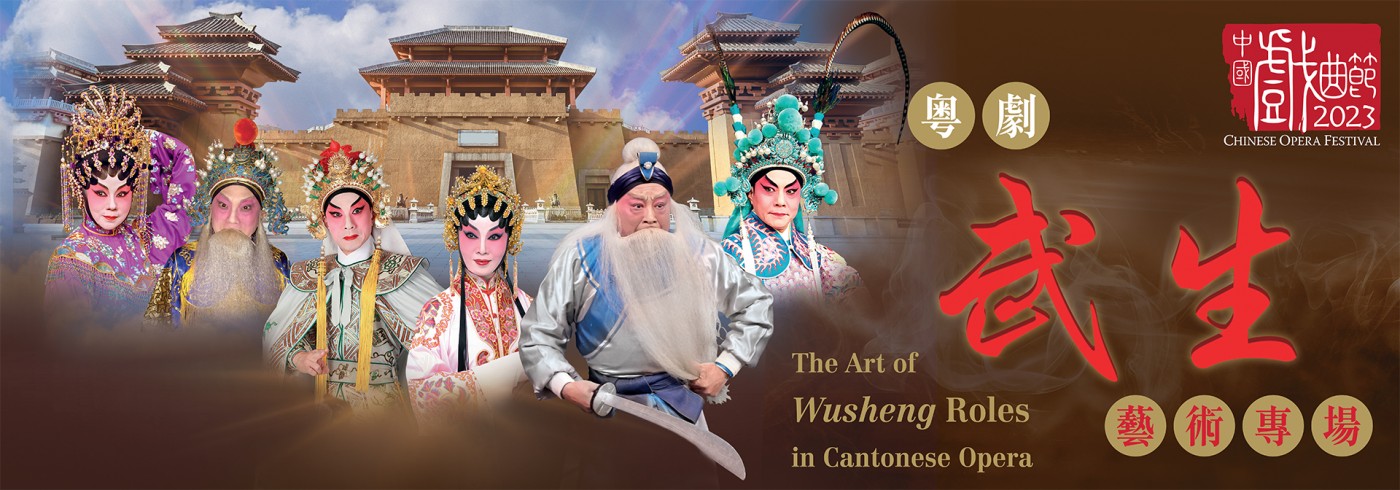
With renowned wusheng actor Liu Kwok-sum as Artistic Director, the showcase titled ‘The Art of Wusheng Roles in Cantonese Opera’ features a star-studded cast including Lee Lung, Wan Fai-yin, Lui Hung-kwong, Chan Ka-ming, and Yuen Siu-fai. It will be an exemplary selection from the wusheng repertoire. First there is the impressive entrance of the actor miming ‘riding a chariot’ in Prime Minister of Six States, with the stylised movements taught hands-on by the venerable Lan Chi Pak. The wusheng moves arranged by Lan Chi Pak in two scenes from Death of a Loyal Warrior – Forcing His Son to Get onto the Saddle and Killing His Own Son can be seen once again on stage. Burying the Horse from Contention for the Seal has rarely been staged over the last twenty years. In addition, Three Hand Claps to Sever Blood Ties from Wang Baochuan, The Night Trial from Judge Bao’s Night Trial of Guo Huai, Barging into the Yamen from The Impeachment of Yan Song, offer the audience an excellent opportunity to see the intricate artistry of wusheng characterisation in Cantonese Opera.
Lyrics and dialogue with Chinese and English surtitles.
Audience is strongly advised to arrive punctually. Latecommers will only be admitted at a suuitable break.
Co-presenter:
13.7.2023 (Thu) 7:30pm
Prime Minister of Six States
This is one of the traditional set pieces in Cantonese Opera, typically with a large cast and each of the characters executing a different set of stylised movements and routines to demonstrate the solid performing techniques of the troupe. An outstanding feature is the miming of ‘riding a chariot’ by the character Gongsun Yan, here performed by Liu Kwok-sum; he is a mentee of Lan Chi Pak, ‘the King of Wusheng Roles’ and benefitted from the latter’s training. Wan Fai-yin, female lead of the troupe, will perform her routine of ‘pushing the chariot’, so the audience can appreciate the action rapport of the two. Another veteran, Yuen Siu-fai, will play the character of Zhao Suhou. He will show how the stylised movements can synchronise with the percussive points. Other unique movements include Lee Yuen-yee and Lo Lai-see executing ‘the two parasols routine’ and Chan Ka-ming’s ‘tailing parasol routine’. It will be a rare opportunity to see such comprehensive demonstrations on one stage indeed.
Su Qin lobbies the six states to form an alliance against the powerful State of Qin. After successfully forming the alliance, leaders of the six states agree to appoint Su Qin as their joint prime minister. He is showered with honour and gifts when he returns home in triumphant glory.
Main Cast: Lee Lung, Wan Fai-yin, Lui Hung-kwong, Liu Kwok-sum, Chan Ka-ming, Yuen Siu-fai, Pui Jun-hin, Ng Lap-hei, Leung Fei-tung, Li Yuen-yi, Lo Lai-see, Shum Pak-chuen, Wan Yiu-sing, Chung Kui-man, Chu Siu-yat, Lee Ching-yan, Siu Wing-yee, Cheung Siu-lun, Fung Choi-wan, Chin Yin, Mou Lai-yin
ExcerptBeating Hands from Wang Baochuan
‘Three hand claps to sever blood ties’ is a performing routine that actors in wusheng (martial male) roles use quite often to express the breaking up between father and daughter. This excerpt is a duet performance between a wusheng and a zhengyin huadan (leading young female role). With each hand clap, the sentiments and actions between the father and daughter are escalated to a higher level, indicating the mental journey of the characters. This routine can be seen in many Cantonese Opera works, Reunion at Rouge Alley is one of the examples.
Wang Baochuan chooses her husband by throwing an embroidered ball to a crowd of male candidates. The ball for marriage falls into the hands of a destitute young man Xue Pinggui. Her father the Prime Minister wants to nullify the engagement but she refuses. The father-daughter negotiation leads to a break up, and three hand claps are performed to signify the unwavering positions of the two.
Main Cast: Lee Lung, Wan Fai-yin, Lui Hung-kwong, Liu Kwok-sum, Chan Ka-ming, Yuen Siu-fai, Pui Jun-hin, Ng Lap-hei, Li Yuen-yi, Lo Lai-see
Judge Bao’s Night Trial of Guo Huai (Screenplay Arrangement: Yuen Siu-fai)
In this performance, Judge Bao (Hualian, literally ‘painted face’) is played by wusheng. It features many stylised movements and singing in a deep voice. The late Cantonese Opera maestro Lan Chi Pak used his unique style of singing to render the character of Judge Bao with form and substance, and his performance is still relished by opera fans to this day. Judge Bao makes use of Guo Huai’s sense of guilt and fear of the spirits to make him confess his crime voluntarily, and justice is eventually served. This is one of the classics among the many stories of Judge Bao.
The story takes place during the reign of Emperor Zhenzong of the Song dynasty. While the emperor is on an expedition, Royal Concubine Liu conspires with Guo Huai the eunuch to replace Royal Concubine Li’s newborn prince with a dead cat, and orders Kouzhu the palace maid to take the baby away and have him killed. Kouzhu does not have the heart to kill the baby. She works with the loyal eunuch Chen Lin to hide it and gives it to the Eighth Prince to raise. When the Emperor returns, Lady Liu accuses Lady Li of giving birth to a cat. Lady Li is sentenced to abandonment at the cold palace, while Lady Liu becomes the Queen Consort. Since she is barren, the Eighth Prince offers her the baby as godson. Chen Lin wants to bring the young prince to the Jade Cloud Palace, but Guo Huai catches the news and sets the palace on fire. On knowing the plot, Kouzhu hurries to inform Lady Li to flee. Kouzhu’s plan is unfortunately leaked and she is beaten to death by the Queen Consort. Eighteen years later, the young prince succeeds the throne. One day, Judge Bao is on his way to Chenzhou when his official headgear is blown away by a mysterious gust. While chasing after it, he runs into a vegetable vendor Guo Haishou who has been giving shelter to Lady Li. On knowing what has happened to Lady Li, Judge Bao reopens the case. Pretending to be the King of Hell, he sets up a night trial of Guo Huai; and with his acuity, he solves the mysterious case in the end. The young emperor finally finds out the truth and is reunited with his mother, Lady Li.
Main Cast: Lee Lung, Wan Fai-yin, Lui Hung-kwong, Liu Kwok-sum, Chan Ka-ming, Yuen Siu-fai, Pui Jun-hin, Ng Lap-hei, Lo Lai-see
14.7.2023 (Fri) 7:30pm
Contention for the Seal
It is a pity that for the last two decades, in order to shorten the duration of the show, the act of Burying the Horse in the original script of Contention for the Seal is often cut. This excerpt is about Shangguan Weiguo and his horse which is seriously injured and unable to continue fighting. Weiguo has no choice but to kill his beloved horse and buries it under the cliff. A wusheng actor is trained to use various detailed stylised movements to interpret the emotions of the character. In this performance, the entire act of Burying the Horse in the play will be staged to allow the audience to see how the original version was like. It is therefore a performance not to be missed.
Shangguan Yunlong has been conferred the title of Marquis of Pingnan for putting down an uprising of the southern barbarians, and bestowed with an imperial sword from the Emperor. At the same time, Situ Wenfeng has been conferred the title of Marquise of Pingxi for quelling unrest on the western front, and granted a death-exemption token. On imperial orders to visit their native places, they meet in the streets and a confrontation follows as neither refuses to give way. They decide to bring the dispute to the Emperor for a ruling, failing which both threaten to resign. Caught in a dilemma, the Emperor confers with their parents, Ministers Shangguan Weiguo and Situ Weijun, and comes up with a trick: he would confer upon Wenfeng the title of ‘Princess Royal’ and gives the secret order that she is to marry Yunlong. He also orders the two fathers to keep this secret from their children. On their wedding night, Yunlong and Wenfeng find out whom they are marrying, but have already come to a point when they cannot back out. Pride gets in the way of any reconciliation and they spend their wedding night apart. The next morning, news arrives that the northern Di barbarians are infringing the borders. The two contend to be appointed commander. The Emperor, on seeing that they are equal in their martial skills, decides that they will draw lots to determine who will be the commander. Wenfeng wins, and when she calls the roll, Yunlong deliberately arrives late. He is sent to meet the enemy force with his own squad as punishment. When his squad is losing ground, he has to shoot an arrow to ask for reinforcement from the camp. Wenfeng takes the entire army to come to his aid and the enemy is annihilated. The two reconcile and return to the imperial court in victory.
Main Cast: Lee Lung, Wan Fai-yin, Yuen Siu-fai, Liu Kwok-sum, Chan Ka-ming, Lui Hung-kwong
15.7.2023 (Sat) 7:30pm
Death of a Loyal Warrior
This is a show first staged by the Chung San Sing Cantonese Opera Troupe and has remained very popular since. The drastic change in emotions and mindset of the actor playing Zhong Yujun are distinctly portrayed in the opening act Forcing His Son to Get onto the Saddle and the final act Killing His Own Son. In the former, Zhong is depicted as a fiercely loyal, patriotic and stubborn old commander; but in the latter, he is a helpless, heartbroken, loving father who is forced by the emperor to execute his own son. The stage directions and stylised movements to externalise the tragic change were devised, rehearsed and performed by the late Lan Chi Pak, who was esteemed as ‘the King of Wusheng Roles’, so he was practically the stage director of these two acts at that time. The present staging has revived the two acts to let the audience today appreciate the artistry and legacy of the veteran actor.
The story takes place during the Ming dynasty. The fatuous Emperor is facing serious troubles within his empire and abroad. The frontier is guarded by the patriotic family of Marshal Zhong Yujun, whose elder son Xiaoquan is talented in both literary and martial arts. Xiaoquan suspects the Consort’s father for conspiring with the King of Wala, and is waiting to hear from his brother Xiaoyi who is gathering intelligence on the enemy. However, the Marshal mistakes Xiaoquan’s prudence as cowardice, and orders him to go ahead with the expedition. Xiaoyi discovers the enemy’s plot against Xiaoquan and hurries to rescue his brother from an ambush. At the meantime, the Consort’s father slanders Xiaoquan before the Emperor. Xiaoquan is thus summoned by the Emperor, and is subject to military discipline if he defies the order. While everyone is in disarray, the Consort’s father arrives with the golden token from the Emperor, threatening to execute the entire Zhong family if Xiaoquan does not return to the court immediately. Xiaoquan has no choice but to follow the order. Deceived by the rumours, the Emperor dismisses Xiaoquan from his position. Zhong Yujun also falls into the trap of the villains, thinking that the ruthlessness of his son has triggered the invasion of the enemies. Zhong Yujun strikes Xiaoquan in anger with his sabre, wanting to execute him with his own hands. At the same time, the Consort’s father arrives with the royal decree and announces that Xiaoquan be executed. Despite coming back with the proof of the Consort’s father’s treason, it is already too late for Xiaoyi to rescue his brother who has been executed by the Consort’s father. To avenge his brother, Xiaoyi strikes his sabre and kills the villain on the spot.
Main Cast: Lee Lung, Wan Fai-yin, Lui Hung-kwong, Liu Kwok-sum, Chan Ka-ming, Yuen Siu-fai, Pui Jun-hin
16.7.2023 (Sun) 2pm
The Impeachment of Yan Song
In the earlier days, many hualian (painted face) roles are played by wusheng (martial male); whereas in recent years, hualian roles are played by chou (comic). The character of Yan Song will be played by wusheng this time, as in the early practice. The two acts On a Rampage and Shattering the Royal Sedan Chair vividly illustrate the arrogance and ruthlessness of Yan Song. There is a long passage of percussion-accompanied dialogue between the wusheng and the wenwusheng (civil and martial male role) recited in guanhua (Mandarin from the Zhongzhou area). In the court scene, the actor playing Yan Song needs to perform miming actions in sync with the percussion cues. One example is ‘sitting with an imposing air on the chair’, which is a display of the solid skills and physical strength of the actor, in particular with the support of the waist and the thighs. In the final act of The Impeachment of Yan Song, when his treachery of conspiring with the Japanese invaders is exposed, his mien and gait change from arrogance and defiance to faint-hearted cowardice for fear of his life. Through various stylised movements, the actor vividly portrays the changing faces of the character with brilliance.
The story takes place during the Jiajing reign of the Ming dynasty. The Emperor indulges in Taoist practices and spending time with his beautiful concubines, leaving governance to his ministers. Yan Song amasses power, takes bribes and extorts exorbitantly high taxes to the demise of the common folks. Emperor Jiajing has already decreed that anyone who impeaches Yan Song, father of his favourite concubine, will be executed, but Inspector Hai Rui, undeterred by the powers-that-be, submits ten memorials to impeach Yan Song. So on receiving Hai Rui’s memorials, Emperor Jiajing is furious. He orders to strip Hai Rui of his official title, and sends Hai Rui to prison to await execution. At that juncture, Yan Song’s son, Yan Shifan, is exposed for delaying military manoeuvres and colluding with Japanese pirates. The Emperor Jiajing confiscates all of Yan Song’s assets and revisits accusations of his dereliction of duty. Yan Shifan is executed after proven guilty, but Yan Song is pardoned from death in view of his decades of service at court. The stricken Yan Song ends up being a beggar in the streets.
Main Cast: Lee Lung, Wan Fai-yin, Lui Hung-kwong, Liu Kwok-sum, Chan Ka-ming, Yuen Siu-fai, Pui Jun-hin
The running time of the performance is approximately 3 hours and 30 minutes including an intermission of 15 minutes.
Lyrics and dialogue with Chinese and English surtitles.
Information provided by the arts group.
Artistic Director: Liu Kwok-sum
Screenplay Arrangement for Judge Bao’s Night Trial of Guo Huai: Yuen Siu-fai
Percussion Leader: Ko Yun-kuen
Ensemble Leader: Chan Siu-lung
Administrator and Coordinator: Lam Kwan-ling
Martial Art Advisor: Han Yan-ming
Stage Manager/ Lighting Design: Cheng Shui-wah
General Affairs: Chan Kin-yat
Props and Costume: Sun Kwan Ying Production Company
Lighting and Set: Kwong Hing Stage Scene Production Company
Chinese Opera Festival 2023: The Art of Wusheng Roles in Cantonese Opera
DATE
VENUE
PRICE
13.07.2023 (Thu) 19:30
14.07.2023 (Fri) 19:30
15.07.2023 (Sat) 19:30
16.07.2023 (Sun) 14:00
Grand Theatre, Xiqu Centre, West Kowloon Cultural District
Tickets available from 12 May at all URBTIX outlets, self-service ticketing kiosks, on internet, by mobile app, telephone and at the Xiqu Centre Ticket Office.
Half-price tickets available for senior citizens aged 60 and above, people with disabilities and the minder, full-time students and Comprehensive Social Security Assistance (CSSA) recipients. (Limited tickets for CSSA recipients available on a first-come, first-served basis.)
Group Booking Discount – 10% off for each purchase of 4-9 standard tickets; 15% off for 10-19 standard tickets; 20% off for 20 or more standard tickets.
‘Chinese Opera Festival 2023’ Package Discount – For each purchase of standard tickets for different Chinese Opera Festival 2023 performances, the following concession applies: 10% off for 3-4 different performances; 20% off for 5 or more different performances.
Patrons can enjoy only one of the above discount offers. Please inform the box office staff at the time of purchase.
Smart Price – You can enjoy a further reduction of $9 per ticket, even if you are already eligible for half-price / group booking / package discounts, by booking through the URBTIX website, mobile app or telephone.
Programme Enquiries: 2268 7325
Ticketing Enquiries and Customer Service: 3166 1100


 BUY TICKET