
|
18
Thu
Apr
2018
19:30
|
06
Wed
Jun
2018
19:30 |

|
$50 |

|
Lecture Hall, Hong Kong Space Museum |
 BUY TICKET
Music
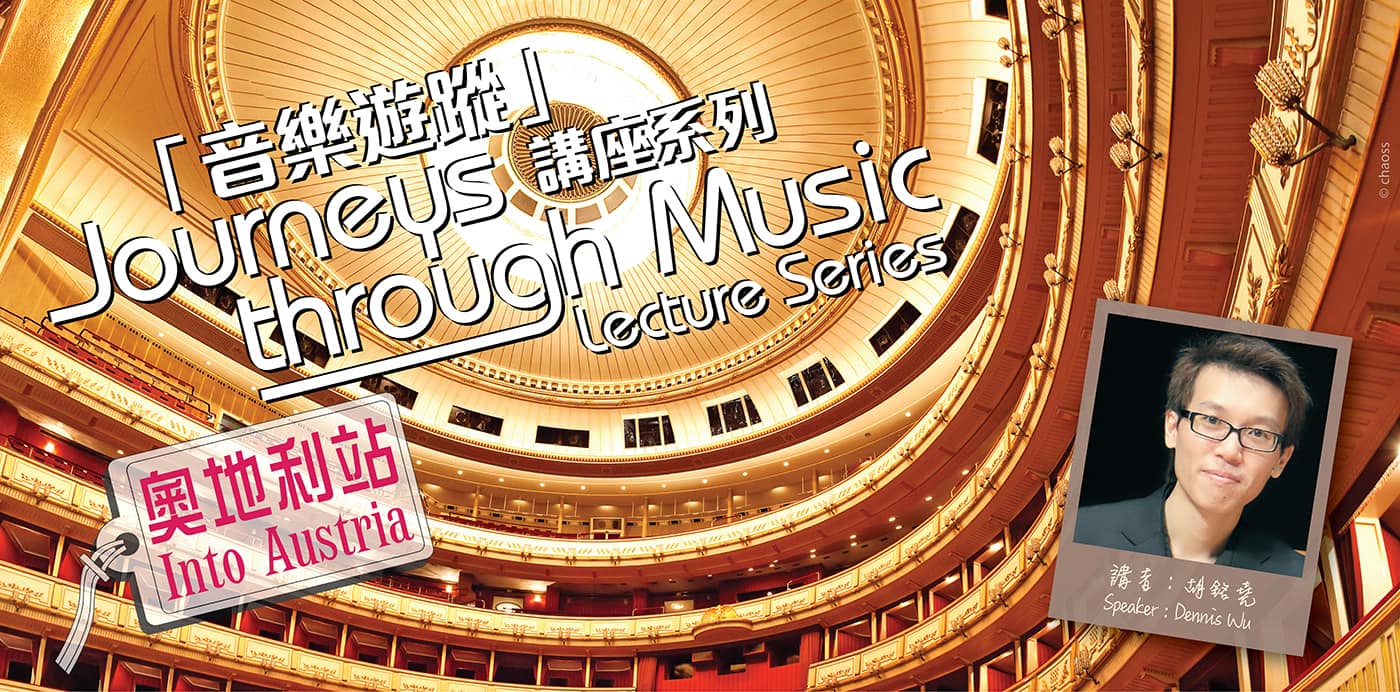
“Journeys through Music” Lecture Series: Into Austria
Austria, home to the "world music capital" of Vienna, is a country of might and influence and the motherland of many great music composers. The political setting, particularly after the long and stable Habsburg rule, provides a unique backdrop for classicism to arise. Its lush scenery and ethnically hybrid population have transformed art music into a unique blend of philosophical quest and earthly delights. With much acclaim in past seasons, "Journey Through Music" lecture series is back, with Dennis Wu discussing the lives, the music and the cultural setting of music from one of the most influential empires in Europe.
18 April Joseph Haydn (1732–1809)
"In addition to performing and teaching, Haydn was indefatigable in composing," Haydn's earliest biographer justifiably commented on his long, sustained and untiring years of creativity. Now best remembered for his hundred symphonies, dozens quartets and sonatas, he was known at his time primarily as the opera impresario, having worked in the reputable court of Esterházy for almost three decades. With his international fame as the grand master of stylised music, later known as "classical music", he gained in the last years of his long career independence from court contracts and servitudes. With his crafts he ushered music, and how music is produced and consumed, into modernity.
25 April Wolfgang Amadeus Mozart (1756–91)
Smart kids naturally attract attention, but no similar person has commanded the world's attention more than Mozart, and continues to do so beyond his 36 years of earthly life. A born polyglot, his music fuses European idioms into a style uniquely his. His output ranges from instrumental to opera, from large scale to small, from humorous to meditational, and he excels in them all. Remembered as an "eternal child", his colourful life is tensioned between family, royals and professionals. In this regard his success, measured by popularity and accessibility, is not purely "of genius", but also of his own eclectic personality, imagination and diligence.
2 May Carl Czerny (1791–1857)
A pre-eminent student of Beethoven, Czerny was entrusted by the master to edit his music, perform premieres and safe keep his manuscripts. He could recall all Beethoven's work without the assistance of manuscript, yet saw himself as an able pedagogue rather than a great pianist. Among his students is Franz Liszt. We now vaguely know the composer, only remembering his torturous opus by the numbers "740" and "299". With this large number, one can easily imagine him being a prolific composer. By looking at the life and works of Czerny, we connect Beethoven with Liszt, the ideology of composition between classicism and romanticism, and musical phenomenon that influences to this day.
9 May Franz Schubert (1797–1828)
Schubert's life is perhaps as enigmatic as his music. "Inwardly a poet and outwardly a kind of hedonist", his life can be assumed to have been lacking dramatic upheavals, or constantly immersed in despair. Scholars find hard times in defining Schubertian style; theorists find it amusing when revealing and theorising the eccentricity of Schubert's works from traditions. Yet, it is the subtlety and fleeting colours of Schubert's music, together with its deep beauty therein, making powerful impacts on personal experiences, which in turn were crucial in artistic expression in the 19th century.
16 May Johann Strauss II (1825–99)
Under the shadow of the father with the same name, the younger Johann Strauss's musical fame came only after the older man died. His father originally wished his son to be a middle-class financier, not a musician like him. However the talent of young Johann proved himself a worthy, if not superior, successor to his father's orchestra. Fed on the insatiable appetite of rural dance music modernised into its metropolitan form, he created waltzes that, other than being internationally famous, became centrepieces of concert halls and, with the circumstances of the creation of those waltzes, chronicled European history of events large and small.
23 May Anton Bruckner (1824–96)
A solitary, deeply religious man, Bruckner had only a few friends in metropolitan Vienna. Principally an organist in royal chapel and noted for his superb skill in improvisation, he wrote lengthy symphonies to incite audience discomfort and the distaste of critics. His admiration and closeness to Wagner drew him even more adversaries. Constantly revising his music, his sense of insecurity in the creative process became puzzling points for debate for modern scholars and performers. However, the tide turned and his innovations were increasingly understood as visionary with lasting influences on symphonists to come.
30 May Hugo Wolf (1860–1903)
"You ask me about the opera! Dear God, I would be contented if I could write the smallest song, let alone an opera!" Unhappy being a song writer as it seems, Wolf wrote some of the most expressive and original songs that are no less rich than an opera in emotion, harmony and intensity. A fierce critic, he dared to invoke debate with a visionary sense of what values music should imbue, and opposed to music, particularly of Brahms, that is divorced from human words. Living a fiery life dedicated to music as a "fire-rider", he found his mission in finding truthfulness of life in music.
6 June Alban Berg (1885–1935)
A student of Schoenberg, in the beginning Berg was instructed to write minuets, scherzos and other small-scale dance because his teacher thought him incapable of writing instrumental themes. His teacher became a fatherly figure, casting deep shadows over the young Berg while finding his own voice. However, as an enthusiastic person "receptive to beautiful whether old or new", Berg soon found a way of writing atonal music with nods to tonal past, framing a symphony within an opera, and expressing subjective ideas over an objective, overarching structure. The most popular modernist composer in Vienna was endowed with an artistic vision way ahead of his time.
Each lecture will run about 1 hour and 30 minutes.
The programme does not represent the views of the Leisure and Cultural Services Department.
The presenter reserves the right to change the programme and speaker.
TICKETING
DATE VENUE PRICE 18.04.2018 - 06.06.2018
(Every Wed, 7:30pm, 8 lectures in total)
(Every Wed, 7:30pm, 8 lectures in total)
Lecture Hall, Hong Kong Space Museum
$50
DATE18.04.2018 - 06.06.2018
(Every Wed, 7:30pm, 8 lectures in total)
(Every Wed, 7:30pm, 8 lectures in total)
PRICE
$50